CatUDP'S blog
After upgrading to the new antenna,
I continued observing east-to-west flight paths —
the ones related to the Mount Fuji reflection hypothesis 🗻
Three distinct routes emerged from the data: A, B, and C.
Interestingly, these align with known airway structures visible in FlightRadar24 map layers.
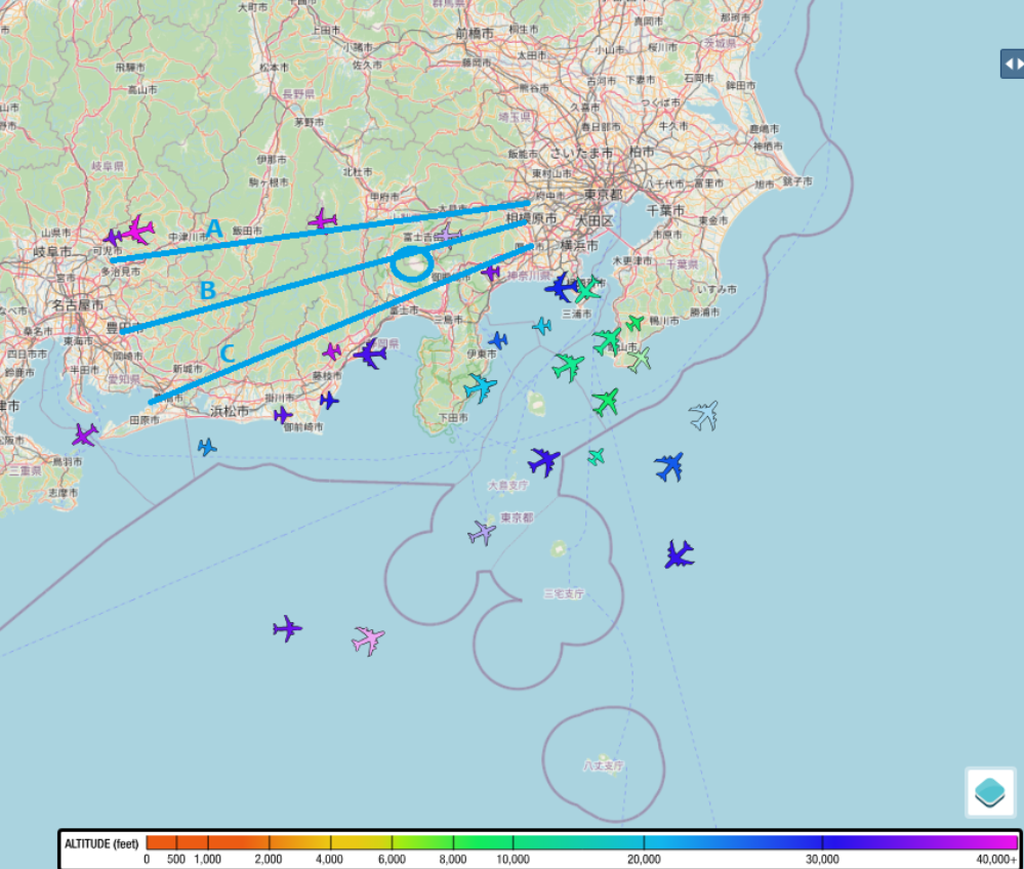
Route A
Not visible with the V-dipole antenna,
but continuously tracked with the new antenna.
- Altitude: 30,000–40,000 ft (high altitude)
- Over mountainous regions
Route B
With the V-dipole antenna:
Signal was lost near Mount Fuji and did not recover.
With the new antenna:
Signal is lost near Mount Fuji, but reappears after passing the area.
- Altitude: 20,000–30,000 ft (daytime)
- Over mountainous regions
Route C
With the V-dipole antenna:
Signal was lost near Mount Fuji, then reappeared near Toyohashi.
With the new antenna:
Tracked continuously without loss.
- Altitude: 20,000–40,000 ft (daytime)
- Over coastal plains
What Changed?
The improved antenna performance allowed weaker signals to be received.
As a result,
the signal loss behavior in Route B became clearly observable.
- Line-of-sight (LOS) is blocked by Mount Fuji
- Direct signal path is interrupted
→ Signal disappears
Why Is the West Still Strong?
Reception from W to SW remains unusually strong.
Possible explanations:
- Mountain reflection
- Ridge diffraction
- Terrain-induced multipath
👉 Signals appear from directions that should be blocked
Observed Behavior (Route B)
Closer observation reveals a pattern consistent with diffraction:
① Before Mount Fuji
Signal received normally (LOS clear)
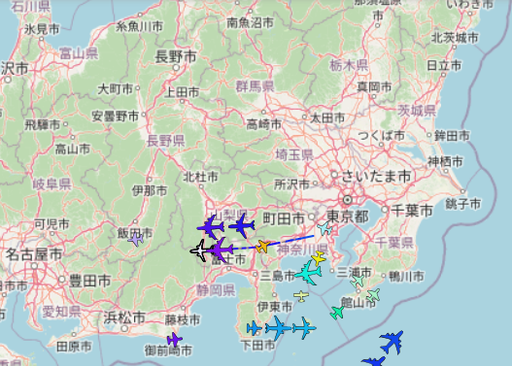
② Near Mount Fuji
Signal disappears
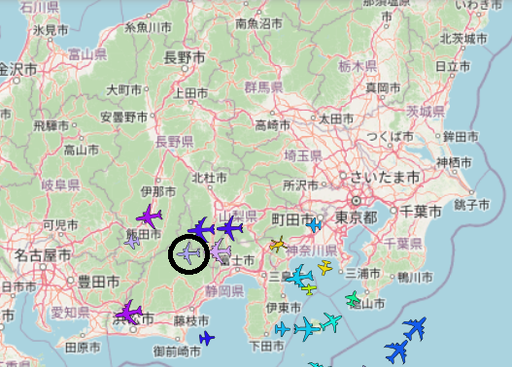
③ After Passing Mount Fuji
Signal reappears
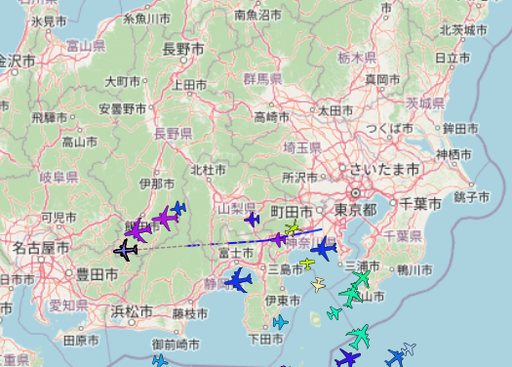
Interpretation (Hypothesis)
Based on these observations:
Route A
High-altitude signals were too weak to be detected with the previous antenna.
Route B
Even if diffraction components existed behind Mount Fuji,
they were too weak to be received with the previous antenna.
Route C
The signal recovery near Toyohashi may not be explained by direct path alone.
Reflected or alternate propagation paths may have contributed.
Reflection vs Diffraction
| Feature | Reflection | Diffraction |
|---|---|---|
| Position | Shifted | Along shadow region |
| Signal Strength | Sometimes strong | Weak but consistent |
| Pattern | Point-like | Area-like |
| This case | ❌ | ✅ |
👉 In this case,
the signal reappears within the shadow region.
→ This strongly suggests diffraction
Conceptual Model
- Route A → Clear line-of-sight
- Route B → Edge interaction (signal loss)
- Route C → Diffraction zone (signal recovery)
The behavior observed along Route B strongly resembles a diffraction pattern rather than simple reflection.
The signal disappears near the obstacle and reappears behind it, consistent with edge diffraction.
🐈 Summary
- Strong reception to the west → Terrain effects
- Route B → Likely diffraction
- NE anomaly → Possibly a different mechanism (reflection or abnormal propagation)
Further observation will be needed to determine the dominant propagation mechanism.
This remains an observational hypothesis and requires further controlled experiments.